Short answer: No — there is no cure for herpes, and no supplement has been proven to cure it; antivirals can prevent or shorten outbreaks, and daily suppressive therapy makes passing it to a partner less likely.
If you have just been diagnosed, or you are tired of outbreaks, "is herpes curable?" is often the first question people ask — and the question most likely to lead to a sales page. The CDC's answer: there is no cure for genital herpes, and anyone selling you one is selling a claim, not a cure.
We have not hands-on tested TonicGreens. This article is general information only, not medical advice. If you have symptoms, talk to a clinician about diagnosis and treatment.
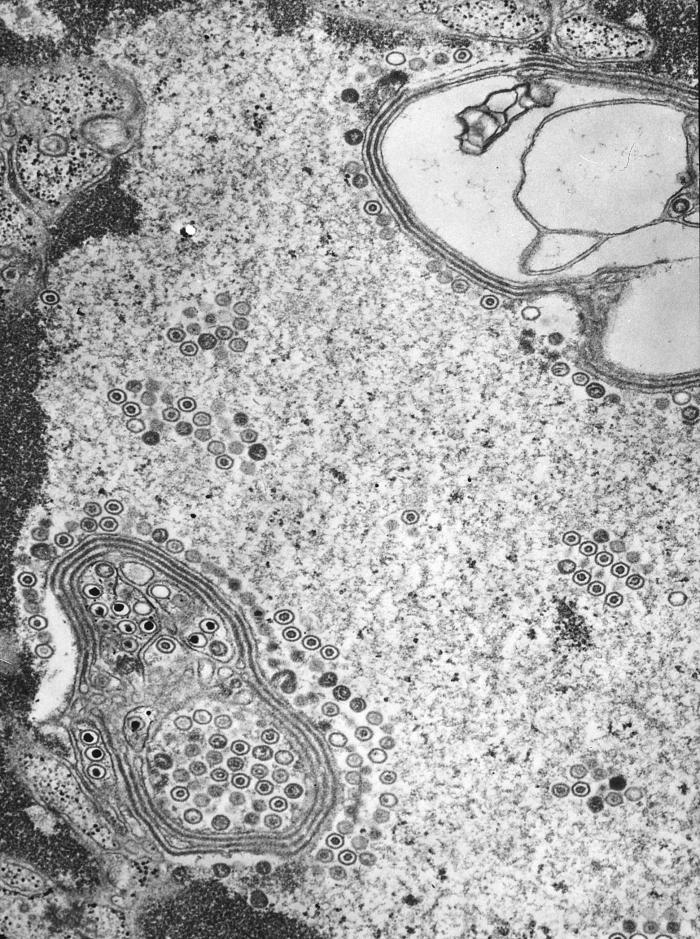
Cover image: CDC Public Health Image Library, PHIL ID 10261, public domain.
Affiliate disclosure: links in this article are affiliate links. If you buy through them, we may earn a commission at no extra cost to you.
Is herpes curable?
Short answer: No. There is no cure for genital herpes or oral herpes — the virus stays in the body for life, and treatment aims at controlling outbreaks, not removing the virus.
After the first infection, the virus retreats into nerve cells, where it stays quiet — latent — for life, waking up again as an outbreak. Medicines cannot reach in and remove it, which is why the CDC states plainly that there is no cure for genital herpes.
That answer also protects you from wasting money: a product claiming to "eliminate the herpes virus" promises what no medicine can do. The honest question is not "how to get rid of herpes" for good — that is not currently possible — but how to control it, starting with antivirals from a clinician.
About 11.9% of US adults aged 14–49 have HSV-2 (CDC, 2015–2016), many without knowing it.
What are herpes symptoms?
Short answer: Most people with herpes have no symptoms, or symptoms so mild they go unnoticed; the first outbreak usually shows up 2–12 days after exposure as painful blisters or sores, often with flu-like symptoms — the usual HSV symptoms.
When symptoms appear, the first outbreak is usually the worst, and repeat outbreaks are usually shorter and milder. Herpes symptoms are easy to miss, which is part of why the virus spreads.
HSV-1 is usually oral and HSV-2 usually genital, but either type can infect either site, so herpes symptoms can mean cold sores around the mouth or sores around the genitals. The symptoms of HSV 2 follow the same pattern — genital sores, often with flu-like symptoms first time, often nothing at all.
Symptoms of herpes in women follow the same pattern as in men — sores or blisters, sometimes flu-like symptoms, often nothing at all. There is no separate set of "women's symptoms", but most infections are only found by testing, not by a list of herpes signs.
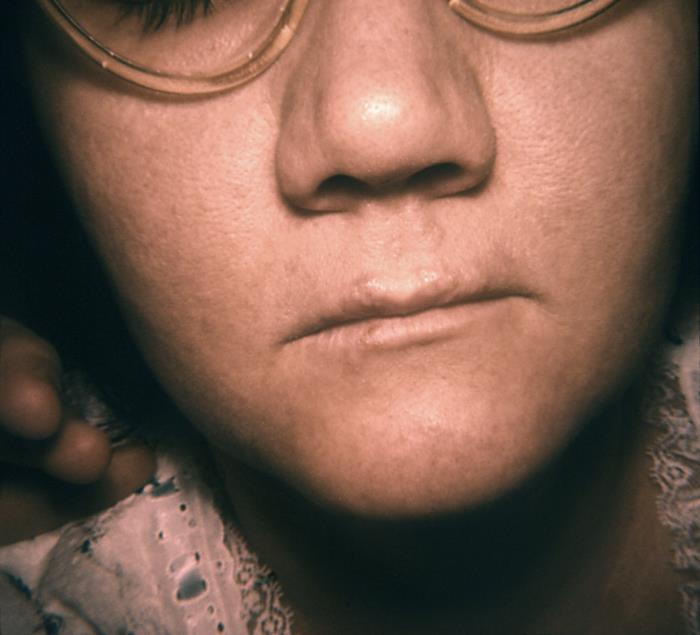
Above: herpes simplex lesions around the mouth — cold sores caused by HSV-1. CDC PHIL ID 5406, public domain.
How does HSV testing actually work?
Short answer: The most accurate test is a PCR swab of an active sore; a blood test (type-specific IgG) detects antibodies, not the virus, and takes about 12 weeks to turn positive. The CDC does not recommend routine screening for people without symptoms.
If you have an active sore, the best test is the simplest: a clinician swabs the sore and tests it by PCR (also called NAAT), which looks for the virus itself.
Without an active sore, the option is a blood test. A herpes IgG test looks for antibodies, not the virus — and antibodies take about 12 weeks to develop, so a test done too soon can come back negative. If you think you were exposed, repeat the test at 12 weeks.
Two things to know before a blood test. First, it must be type-specific IgG — it must tell HSV-1 from HSV-2. Second, do not accept an IgM blood test: IgM tests cannot distinguish the two types and produce false positives. If you searched for an hsv test or an hsv 1 test, the swab gives certainty; the blood test is second-best.
Will there ever be a cure for herpes?
Short answer: Not yet — there is no approved HSV vaccine anywhere, and no cure; several vaccine candidates have failed, and the newest approved drug treats some immunocompromised patients.
The search is real, and it has had a run of disappointments. GSK's vaccine GSK3943104 was stopped in September 2024 after Phase 2 missed its goal. Moderna's mRNA-1608 was stopped in November 2025 and will not move to Phase 3. BioNTech's BNT163 is still in Phase 1 (NCT05432583, ~300 participants) — but Phase 1 tests safety, not whether a vaccine prevents infection. None is a cure.
The newest real development is a drug, not a cure. Pritelivir (Hovilpri) was approved by the FDA on October 9, 2026 for certain immunocompromised patients — but it is not a cure, and it was not approved for the general public.
The most striking laboratory result is also the furthest from patients: researchers at Fred Hutch used gene editing to remove 90–97% of latent HSV-1 in mice — not yet tested in people. So "will there ever be a cure for herpes" is an open question — but as of 2026, there is no cure and no approved vaccine.
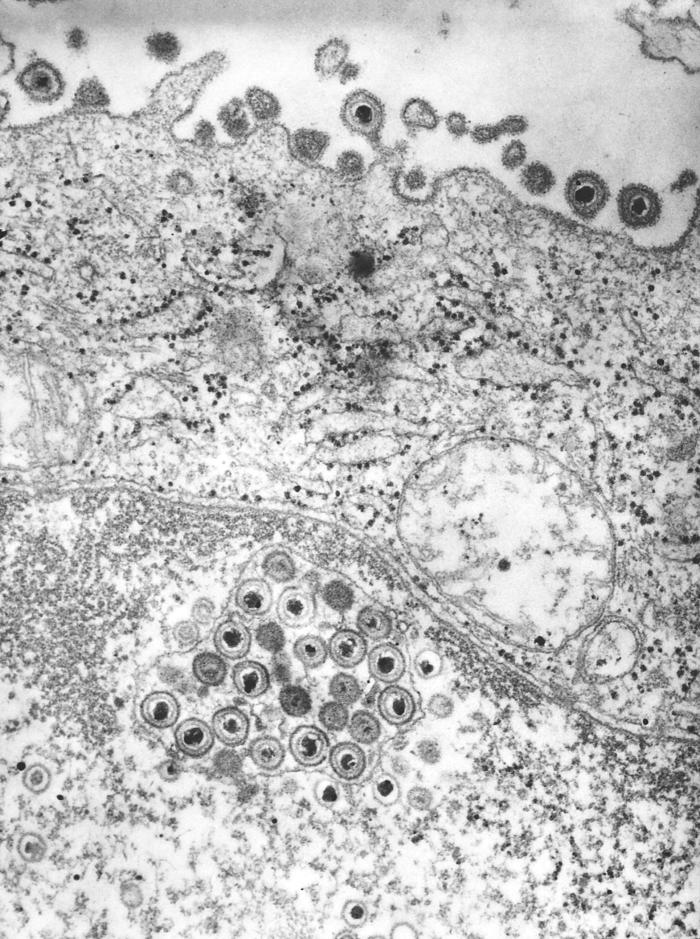
Above: herpes simplex virus virions under a transmission electron microscope. CDC PHIL ID 10260, public domain.
What about the "Dr. Sebi cure" and "I cured my HSV-2" claims?
Short answer: These are unproven claims with no clinical evidence — no diet, herb, or supplement has been shown in a clinical trial to cure herpes, and personal stories are not proof.
Search "dr sebi cure for herpes" and you will find confident promises: a specific diet, alkaline foods, herbs that supposedly flush the virus out. Search "i cured my hsv 2" and you will find personal stories. Both share the same problem: no clinical evidence. No trial has shown any diet, herb, or supplement cures herpes, and a personal story is not evidence — outbreaks come and go on their own.
The danger is not just wasted money: someone who believes they are cured may stop prescribed antivirals or delay seeing a clinician. Without a published clinical trial behind it, treat a cure claim as a story, not a treatment.
What is TonicGreens?
Short answer: TonicGreens is a daily greens powder from tonicggreen.com, with 57 or more ingredients in six groups — and its maker claims it can eliminate the herpes virus, a claim no trial supports.
TonicGreens is a once-a-day powder you mix with water or a smoothie. Its maker lists 57 or more ingredients in six groups: quercetin sources (kale, green tea), a resveratrol berry blend, curcumin, extra antioxidants, an immune phytomix (reishi, shiitake, maitake), and a prebiotic-probiotic blend — see our ingredients breakdown.
Two facts matter more than the list. First, the maker does not disclose how much of each ingredient is in a serving. Second, we do not quote a price anywhere on this site — prices differ across lookalike sites, so check tonicggreen.com.
The maker's central claim is the one that matters: a "SEARCH and DESTROY" process, and TonicGreens described as "clinically tested and proven" to eliminate the herpes virus. That is the maker's claim, not ours — no published trial supporting it was found. The maker also offers a 60-day money-back guarantee, according to its page.
What can TonicGreens do — and what can it not do?
Short answer: TonicGreens cannot cure, treat, or prevent herpes — there is no published evidence that it does; at most it is a greens powder, a nutrition product, not a herpes treatment.
The distinction is simple. TonicGreens is a greens powder — a convenient way to get plant compounds such as quercetin, resveratrol, curcumin, and mushroom extracts into your diet. What it cannot do is remove a latent virus from your nerve cells: no published trial shows that TonicGreens, or any greens powder, cures herpes or prevents transmission.
That does not make the product worthless — it makes the claims the problem. As a daily greens powder for general nutrition, it is a reasonable purchase, and the 60-day guarantee lowers the risk. But as a cure for genital herpes, it is something it has not been shown to do.
Our earlier review reaches the same conclusion — see Herpes and TonicGreens: What the Evidence Actually Says. For day-to-day help, see Living with Herpes Outbreaks: What Actually Helps.
Check the second TonicGreens offer here, and compare it with the first before you decide anything
How to prevent and reduce outbreaks
Short answer: The proven way to prevent genital herpes outbreaks is daily suppressive antiviral therapy, which cuts outbreaks by 70–80% in people who have them frequently — and the plan comes from a clinician, not a supplement.
If you are asking how to stop herpes outbreaks, start with the treatment that has evidence: for frequent outbreaks, daily suppressive antiviral therapy reduces outbreaks by 70–80%, according to the CDC. It also makes passing the virus to a partner less likely.
Genital herpes treatment is not only daily pills: antivirals can also be taken at the first sign of an outbreak to shorten it, and a clinician can help you choose between daily suppression and episodic treatment.
Living with herpes 2 is mostly about management: note when outbreaks happen, keep medicine on hand, and talk to your clinician if outbreaks become more frequent or harder to control.
Safety: talk to a doctor first
Short answer: Ask a clinician before taking TonicGreens or any supplement for herpes — especially if pregnant, nursing, on medication, or immunocompromised — and never stop prescribed antivirals for a supplement.
This is general information, not medical advice, and not a substitute for a clinician who knows your history. Talk to a doctor before taking TonicGreens or any new supplement — especially if pregnant, nursing, on medication, or immunocompromised.
Three rules matter most. First, never stop a prescribed antiviral in favour of a supplement. Second, see a clinician promptly if symptoms are severe, if sores do not heal, or if outbreaks keep returning. Third, ask a clinician before starting any new supplement — especially if you are pregnant, nursing, on medication, or immunocompromised.
Pros and cons
Short answer: The strengths are a broad ingredient list and a 60-day guarantee; the weaknesses are the unproven cure claim, undisclosed amounts, and no published trial — and none of them address herpes itself.
Pros
- Broad ingredient list. 57 or more ingredients across six groups, including quercetin, resveratrol, curcumin, and reishi, shiitake, and maitake.
- 60-day money-back guarantee. Offered by the maker, according to its page.
Cons
- No cure, no treatment, no prevention. TonicGreens has not been shown to cure, treat, or prevent herpes, and no published trial supports the maker's claim.
- Amounts not disclosed. The maker does not say how much of each ingredient is in a serving.
- Cure marketing is misleading. The "SEARCH and DESTROY" language promises more than any supplement has been shown to do.
- Not hands-on tested. We have not used this product ourselves.
- Not a substitute for treatment. Buying it instead of antivirals trades a proven treatment for an unproven one.
Who should buy it — and who should skip it
Short answer: Buy it only if you want a daily greens powder for general nutrition and accept it will not treat herpes; skip it if you are buying it as a cure.
Who should buy it
Short answer: People who want a broad greens powder for general nutrition, who read the maker's claims with scepticism, and who are already getting antiviral treatment if they have herpes.
This fits a narrow buyer: someone who likes a daily greens powder, is comfortable with undisclosed doses, and is not relying on it for herpes. With a clinician's treatment plan in place, it is a reasonable option.
Who should skip it
Short answer: Anyone buying it as a cure for herpes, anyone looking for a replacement for antivirals, and anyone who needs to know exactly what dose of each ingredient they are taking.
Skip it if you are buying it to get rid of herpes — that is not what it does; spend the money on a clinician visit and antivirals instead.
Final verdict
Short answer: TonicGreens is a greens powder, not a herpes cure — there is no cure for herpes, and no supplement has been proven to provide one; spend on antivirals first, and only consider TonicGreens as a general nutrition product, never as a treatment.
The cure question has a clear answer: no, herpes is not curable, not by medicine and not by a supplement. Antivirals control it, testing diagnoses it, and cure research is still in early stages. TonicGreens sits outside all of that — a broad greens powder with a guarantee, sold with a cure claim no published trial supports.
Frequently asked questions
Is herpes curable?
Short answer: No — there is no cure for herpes, and no vaccine is approved; antivirals control outbreaks but do not remove the virus.
The CDC states there is no cure for genital herpes: the virus stays latent in nerve cells for life. Antivirals can prevent or shorten outbreaks, and daily suppressive therapy reduces them by 70–80%.
How do I know if I have herpes?
Short answer: A PCR swab of an active sore is the most accurate test; without a sore, a type-specific IgG blood test works, but takes about 12 weeks to turn positive.
With a sore, ask for a PCR swab — it looks for the virus itself and is the most accurate test. Without a sore, a type-specific IgG blood test looks for antibodies, which take about 12 weeks to develop, so repeat the test at 12 weeks. Do not use IgM tests.
Can TonicGreens cure herpes?
Short answer: No — there is no published evidence that TonicGreens cures, treats, or prevents herpes, and the maker's "clinically tested and proven" claim has no trial behind it.
TonicGreens is a greens powder with 57 or more ingredients in six groups. Its maker claims a "SEARCH and DESTROY" process that eliminates the herpes virus, but no published trial supports that claim.
How can I reduce herpes outbreaks?
Short answer: Daily suppressive antiviral therapy is the proven way, cutting outbreaks by 70–80% in people with frequent outbreaks — ask a clinician.
Antivirals can prevent or shorten outbreaks, and daily suppressive therapy is the strongest option for frequent outbreaks, per the CDC. A clinician can help you choose between daily suppression and episodic treatment.

