Short answer: Make bills in credits and starts free with more room; Zapier bills in tasks and starts free with less room, but has the bigger app library and the simpler first step. The comparison is anchored by a dated release: on October 20, 2026, Make's official blog announced governance features for teams.
How we wrote this: we have not hands-on tested either platform with a paid account. Prices and features below come from each maker's official pricing, product, and help pages, checked on October 30, 2026, and we say so wherever a claim is the maker's rather than our own finding. Prices can change; check the official page before you pay.
Make's October news: governance for teams that keep growing
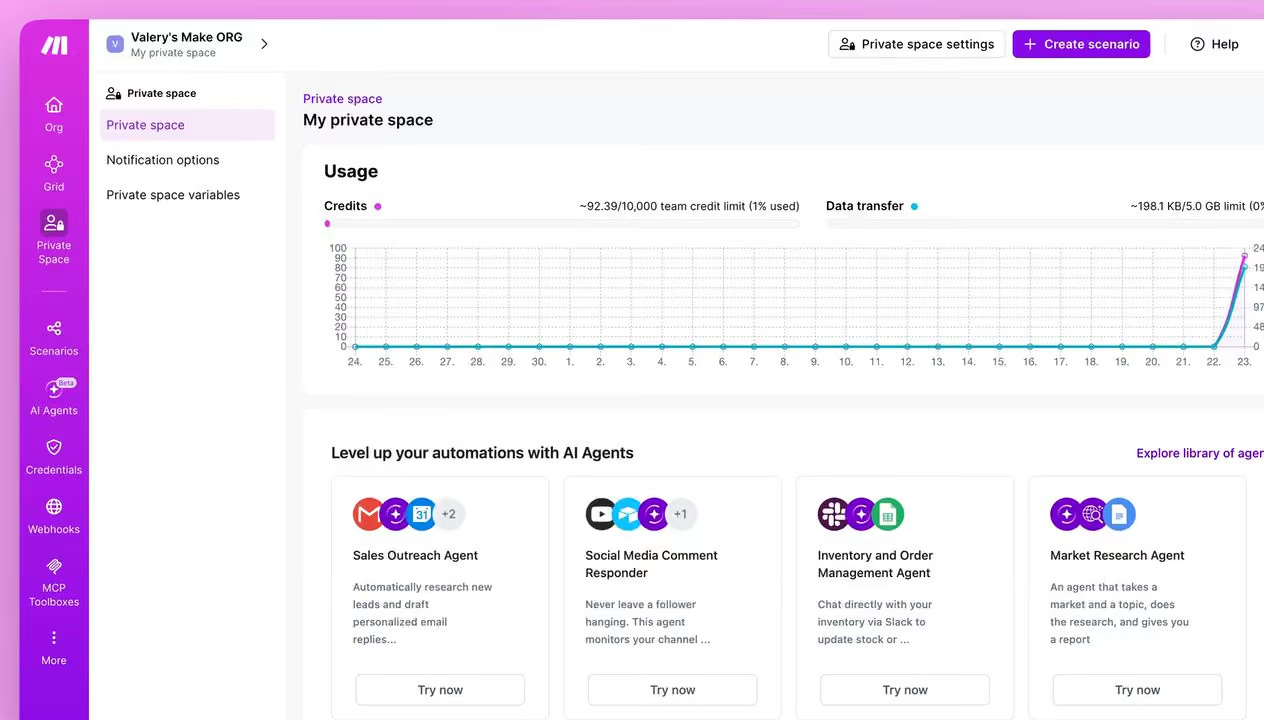
Short answer: on October 20, 2026, Make's official blog announced Private Spaces, new Audit Logs events, real-time email alerts, and Custom Roles — controls for teams where many people build automations in one organisation.
Private Spaces gives every team member an isolated workspace for scenarios and AI agents, hidden from the rest of the organisation by default, and it is available on every Make plan, including Free. New Audit Logs events record identity and credential changes — including two-factor authentication being switched off, role changes, member removals, and a connection or key being used by someone other than its owner — and Audit Logs are available on the Enterprise plan. The real-time email alert for that same credential misuse is available on every plan, so the owner of a shared API key learns the moment a teammate reuses it. Custom Roles, on Enterprise, let admins define roles with exactly the permissions the work needs, instead of an all-or-nothing choice.
Make also announced its next generation of AI Agents, built and debugged inside the scenario canvas, with a Reasoning Panel that shows what the agent is doing. The direction is clear: Make is pitching itself to teams that need automation and the audit trail to prove it is under control. For the platform itself, see our full Make review.
Make vs Zapier: credits against tasks
Short answer: Make bills in credits and starts free with more room; Zapier bills in tasks and starts free with less room, but has the bigger app library and the simpler first step.
| Make | Zapier | |
|---|---|---|
| Billing unit | Credits (most actions cost 1) | Tasks (each successful action) |
| Free plan | 1,000 credits/month, no card, no time limit | $0, 100 tasks/month, two-step Zaps |
| First paid plan | Core / Pro / Teams / Enterprise | Professional from $19.99/month |
| Team plan | Teams | Team from $69/month |
| App library | 3,500+ apps | 9,000+ apps |
| Free trial of paid features | Free plan has no expiry | 14-day Professional trial, no card |
Make's free plan is the more generous starting point: 1,000 credits a month with no time limit, according to its pricing page, and checks that find nothing new still cost credits, so scheduled scenarios burn the allowance even on quiet days. Make's paid prices are shown per visitor on its official pricing page, so check the page on the day rather than trusting a quoted dollar figure here.
Zapier's model is simpler to explain: every successful action in a Zap counts as one task, triggers and failed steps do not count, and checking for new data never costs a task. Its pricing page now puts AI steps, code, and the SDK on the same task-based model, with task tiers from 100 a month on Free up to 2 million on the largest tiers. If you hit your limit, Zapier switches you to pay-per-task billing at a higher per-task rate unless you turn it off, in which case your Zaps pause until the next cycle.
Pick Make if you run longer, branching workflows and want the visual canvas, the cheaper free tier, and the new governance controls. Pick Zapier if you want the simplest possible start, the largest app library, and two-tool automations that just work.

What this means for buyers
Make and Zapier both sell automation, but Make sells depth and control while Zapier sells the easiest first automation — the right choice depends on whether your workflows are simple connections or branching systems. Use the free tier or the 14-day trial to run one real workflow before paying anything.
Frequently asked questions
Does Make or Zapier have the better free plan?
Make's free plan includes 1,000 credits a month with no time limit, while Zapier's free plan includes 100 tasks a month. Make gives you more room to run real automations for free; Zapier gives you the simpler model and the larger app library.
What did Make actually announce in October 2026?
On October 20, 2026, Make's official blog announced Private Spaces (available on every plan including Free), new Audit Logs events and Custom Roles (Enterprise), and real-time email alerts for credential misuse (every plan). Make also announced its next generation of AI Agents, built and debugged inside the scenario canvas with a Reasoning Panel.