
Short answer: a mouth guard moves the jaw forward, a nasal clip opens the nose from within, and a pillow nudges you onto your side — three different fixes for three different causes of snoring, priced at $149.99, $17.99, and $119.99. Prices below are as listed on the maker's own pages on October 31, 2026. We have not hands-on tested any of the three products.
This article is general information only, not medical advice. Nothing in it treats, cures, or prevents any condition, and no product here replaces a conversation with a clinician — especially if snoring may be sleep apnea.
Three approaches, three different causes
Short answer: the guard fixes the throat, the clip fixes the nose, and the pillow fixes the sleeping position — so the right one depends on where your snoring starts.
| Mouth guard (Somnofit-S) | Nasal dilator (Airflow Clip) | Pillow (Posiform) | |
|---|---|---|---|
| How it works | Moves the jaw forward (mandibular advancement) | Expands the nostrils from within | Encourages side-sleeping |
| Price | $149.99 | $17.99 trial pack; $14.99 per size | $119.99 (was $129.99) |
| Return window | 120 nights | 30 days | 120 days |
| Best for | Snoring from the throat or tongue | Stuffy nose, congestion, deviated septum | Back sleepers |
| Worn | In the mouth, overnight | Inside the nostrils, overnight | Under the head, every night |
SnoreLessNow sells all three as its bestselling range, and also bundles them as the Premium Snore No More Bundle at $197.97, listed as $100 off the $297.97 separate total on the maker's homepage. The bundle is the maker's offer, not our recommendation: buying all three only makes sense if more than one cause applies to you.
The mouth guard: the strongest intervention
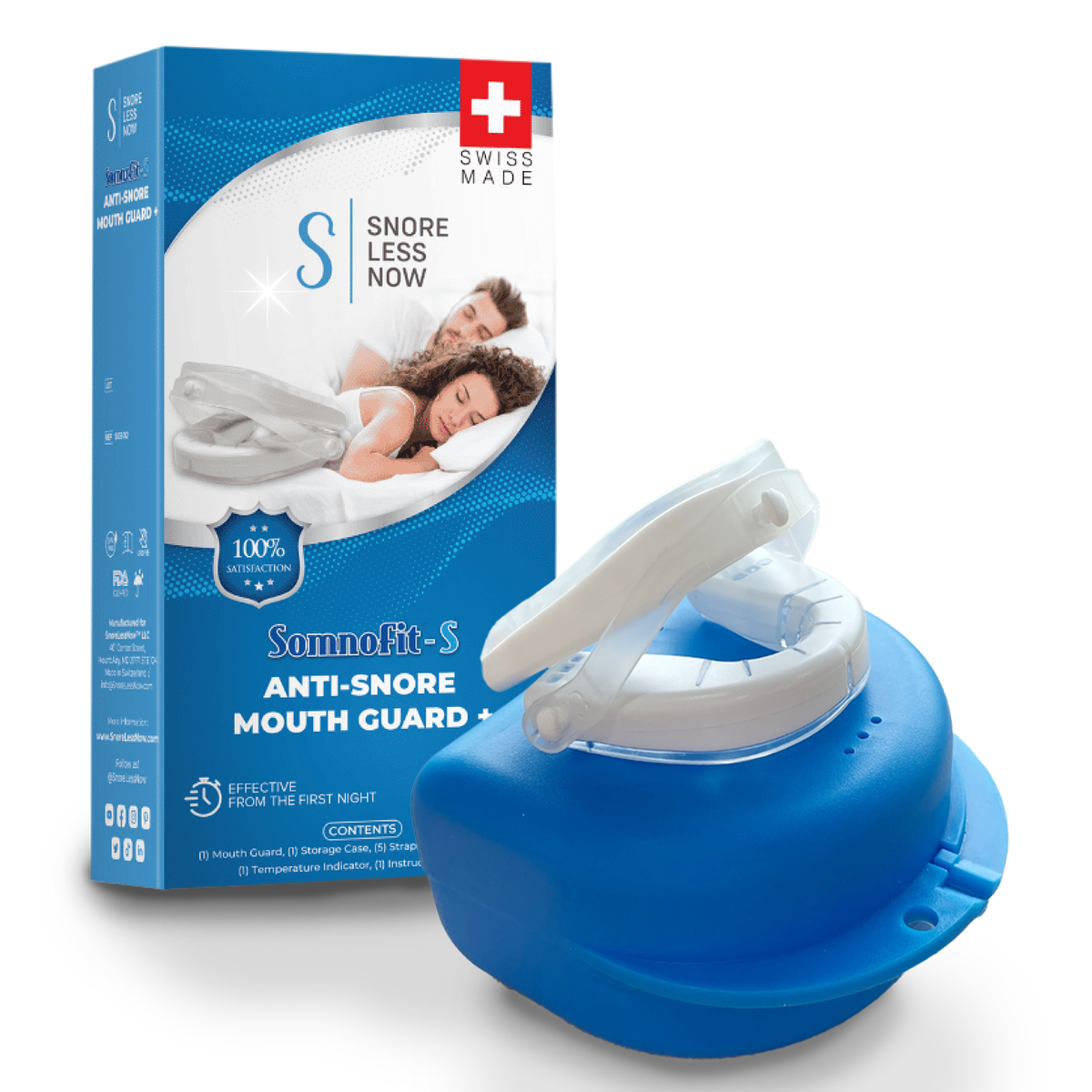
Short answer: the Somnofit-S is the most involved of the three — an FDA-cleared device you mold to your teeth, with five adjustable straps and a 120-night guarantee.
The Somnofit-S is a mandibular advancement device: it gently holds the jaw forward so the airway stays open, which the maker says makes breathing easier and reduces snoring. It is FDA-cleared for snoring reduction, made by the Swiss manufacturer Oscimed SA from medical polymers the maker lists as BPA, phthalate, and latex-free, and it is boil-and-bite, so the fit is molded to your own mouth. The patented adjustable bands let the jaw move freely, so the maker says you can talk and drink while wearing it. Five straps, numbered 1 to 5, set the jaw position: the maker's guide says to start with strap 1 or 2 for an overbite, strap 5 for an underbite, and strap 3 or 4 for a common bite, wearing each strap for three to five nights before tightening. The maker also says the device has sold more than 500,000 units in Europe as the SomnoFit-S, and cites a study in the journal Sleep Science which, according to the product page, found reduced snoring, improved oxygen saturation, and less daytime sleepiness.
The nasal clip: the cheapest first try
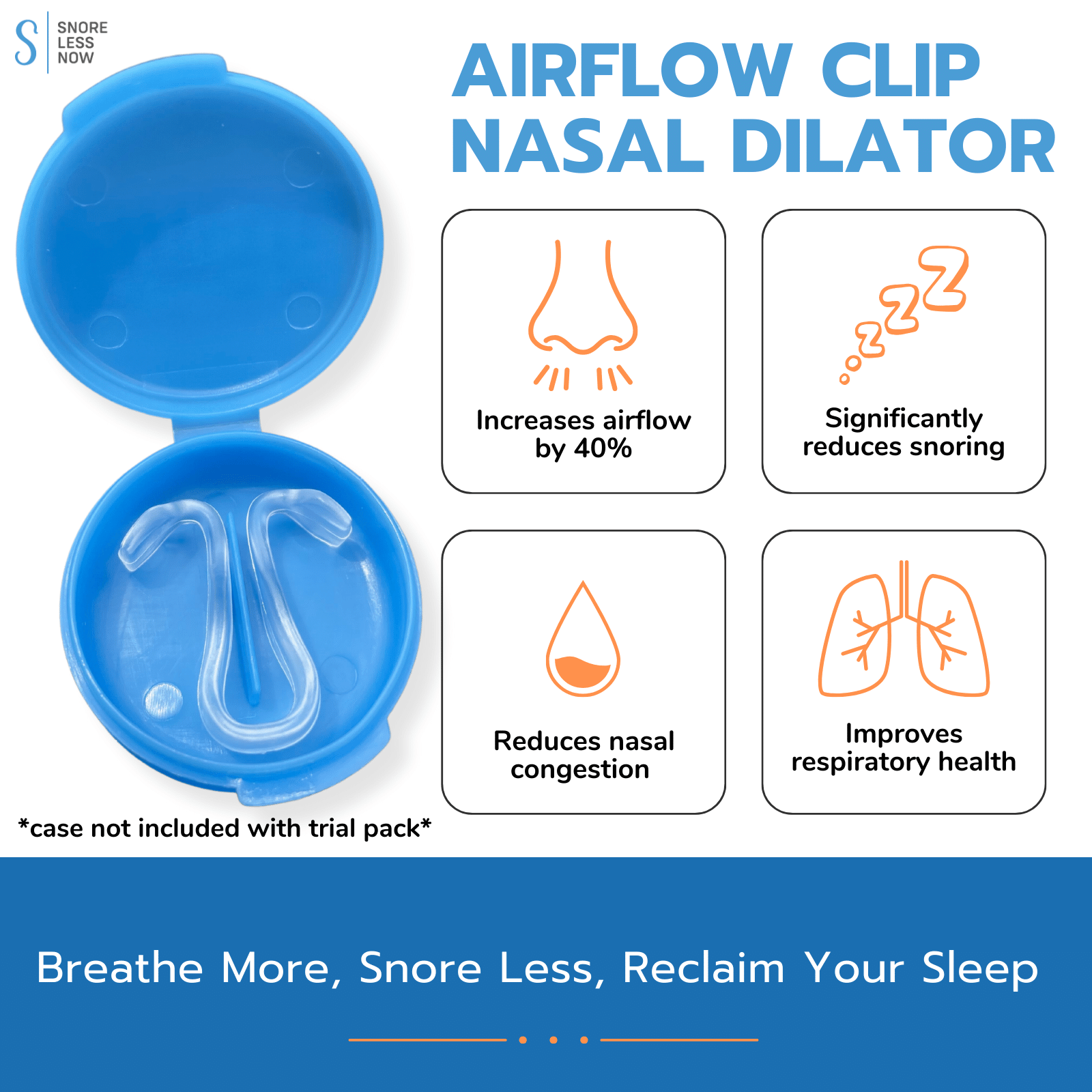
Short answer: the Airflow Clip is a small, reusable dilator that opens the nostrils from within — $17.99 for a trial pack of three sizes, and the cheapest way to test whether the nose is the problem.
The Airflow Clip is a Swiss-engineered, FDA-registered dilator — registered, not FDA-cleared — that sits inside the nostrils and expands them from within. The maker's product page says the design increases airflow by 40%, significantly reducing snoring and nasal congestion while improving respiratory health. Those figures are the maker's claims, not our own findings. The clip is adhesive-free, moldable (the maker says to reshape it in 140°F water for 5 seconds), reusable for up to 90 days, BPA-free, and eligible for HSA and FSA funds, according to the product page. The trial pack includes small, medium, and large, and the maker advises starting with the medium. Single sizes cost $14.99 each. The return window is 30 days, and the maker says the clip is designed to work with CPAP machines.
The pillow: the one that changes how you sleep
Short answer: the Posiform pillow is a Swiss-designed memory foam pillow that keeps you on your side — $119.99, with a 120-day guarantee and a 3-year manufacturer's warranty.
Back sleeping is a leading cause of snoring, according to the maker's pillow page: on your back, the throat's muscles and tongue fall to gravity and narrow the airway. The Posiform pillow is shaped to encourage side-sleeping, with a forehead support, a central ridge that stops rolling onto the back, and cut-outs for the ears and shoulders. The maker lists a memory foam core with a moisture-wicking bamboo outer cover, and says the pillow is OEKO-TEX and CertiPur compliant. The price on the pillow's own page is $119.99, marked down from $129.99, and the page notes a 3-week lead time at the time of writing. The maker also cites a small study — 28 participants with positional obstructive sleep apnea, by Newell, Mairesse, and Neu — reporting significant decreases in sleep disturbances, oxygen desaturation, and apnea-hypopnea episodes after a month of use. That is the maker's citation of a small study, not a finding that a pillow treats sleep apnea.
The caution all three need
Short answer: none of the three treats, cures, or prevents sleep apnea — and snoring can be a sign of it.
Snoring is often harmless, but it can also be a sign of sleep apnea, a condition in which breathing repeatedly stops and starts during sleep. The mouth guard is FDA-cleared for snoring reduction, the nasal clip is FDA-registered, and the pillow is a positioning aid — none of them is a treatment for sleep apnea. Anyone with loud snoring plus gasping or pauses in breathing, daytime sleepiness, morning headaches, or high blood pressure should see a clinician — and get a sleep study if one is recommended — before relying on any anti-snore product. Our guide to SnoreLessNow's anti-snore products carries the same warning in full.
What this means for buyers
Short answer: start with the cheapest test that matches your cause — the clip for a stuffy nose, the pillow for back sleeping, the guard for throat snoring — and see a clinician first if any sleep apnea signs are present.
If your nose is blocked, the $17.99 trial pack is the cheapest experiment: three sizes, 30 days to return it, and an answer in a few nights. If you sleep on your back, the pillow attacks the position itself, and its 120-day guarantee gives the longest trial of the three. If the snoring comes from the throat and you want the strongest option, the mouth guard is the most involved — and the most expensive at $149.99, with the longest return window at 120 nights. The $197.97 bundle only saves money if you would buy more than one of them anyway. SnoreLessNow also sells a Slumber Patch sleep aid ($23.99 for a 30-day supply), which is a sleep aid, not an anti-snore device, so it sits outside this comparison.
Frequently asked questions
Which one should I try first?
It depends on the cause. For a stuffy nose, the $17.99 Airflow Clip trial pack is the cheapest test. For back sleeping, the Posiform pillow. For snoring that comes from the throat, the Somnofit-S mouth guard. If you are unsure of the cause, the cheapest test first is the least expensive way to learn.
Can I use the nasal clip with a CPAP machine?
According to the maker's product page, yes — the Airflow Clip is designed to work with CPAP machines. If you use CPAP, ask your clinician before adding any device to the routine.
How long can I return each one?
The mouth guard has a 120-night money-back guarantee, the pillow has a 120-day money-back guarantee, and the nasal clip has a 30-day money-back guarantee, all according to the maker's own product pages.
Do any of these treat sleep apnea?
No. None of the three is a treatment for sleep apnea. If you have loud snoring with gasping or pauses, daytime sleepiness, morning headaches, or high blood pressure, see a clinician — and get a sleep study if one is recommended — before relying on any anti-snore product.